
FRAMED-POSTER
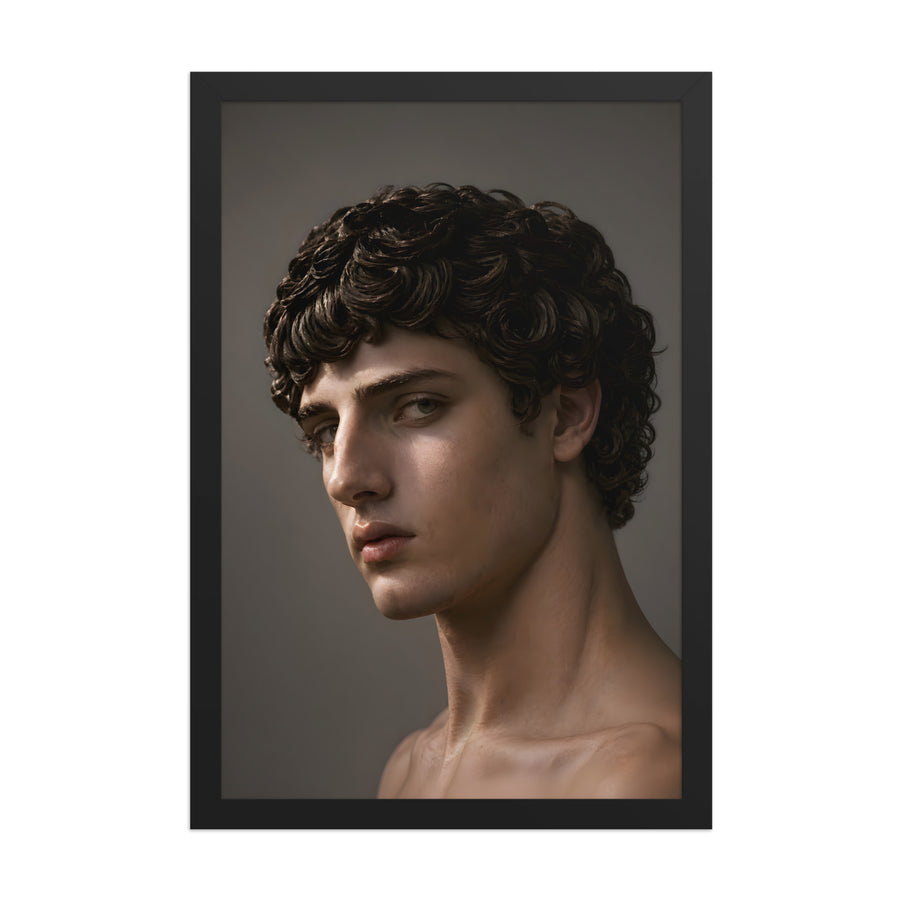
Antinous, Alive — The Delphi Portrait
$44.50
Frame Color — Black
Size
Archival matte paper, fade-resistant inks
Ships in 2–4 business days
Free returns within 30 days
Frame from renewable forests
About this Print
Found under a gymnasium wall. Carved to outlive worship. Here, he looks back.
In 1894, French excavators clearing the sanctuary at Delphi uncovered a nearly intact marble youth built into a wall near the gymnasium — reused as building material, ironically, by people who no longer knew or cared who he'd been. He turned out to be one of the finest surviving portraits of Antinous anywhere in the ancient world: an over-life-size figure in Pentelic marble, carved not long after his death and deification around 130 AD, idealized with the calm, self-possessed nudity of a classical athlete rather than the mourning gravity you see in most Antinous busts. Delphi's priests and worshippers apparently gave him a place among the gods and heroes of the sanctuary — which, for a Bithynian favorite drowned in the Nile, is about as close to actual apotheosis as marble gets.
This portrait starts from that face — the low, dense curls, the level brow, the sidelong, faintly guarded look that made this statue famous among Antinous scholars for feeling less like an icon and more like an actual young man caught mid-thought. We rebuilt it in skin and studio light rather than stone: the same tilt of the head, the same unhurried gaze turned just off-center, as if he's about to say something and hasn't decided whether to.
Where the Patras bust carries grief, the Delphi portrait carries a kind of wary serenity — the face of someone who has just realized he's being looked at, and isn't sure yet whether he minds. It's the pick for anyone who wants their Antinous less as elegy, more as presence.
The statue behind the portrait: Statue of Antinous, Pentelic marble, discovered in 1894 during the French excavations of the Sanctuary of Apollo at Delphi, near the site of the ancient gymnasium. Delphi Archaeological Museum. Dated to shortly after Antinous's deification, c. 130–138 AD.
• Ayous wood .75″ (1.9 cm) thick frame from renewable forests
• Paper thickness: 10.3 mil (0.26 mm)
• Paper weight: 189 g/m²
• Lightweight
• Acrylite front protector
• Hanging hardware included
• Blank product components in the US sourced from Japan and the US
• Blank product components in the EU sourced from Japan and Latvia
In 1894, French excavators clearing the sanctuary at Delphi uncovered a nearly intact marble youth built into a wall near the gymnasium — reused as building material, ironically, by people who no longer knew or cared who he'd been. He turned out to be one of the finest surviving portraits of Antinous anywhere in the ancient world: an over-life-size figure in Pentelic marble, carved not long after his death and deification around 130 AD, idealized with the calm, self-possessed nudity of a classical athlete rather than the mourning gravity you see in most Antinous busts. Delphi's priests and worshippers apparently gave him a place among the gods and heroes of the sanctuary — which, for a Bithynian favorite drowned in the Nile, is about as close to actual apotheosis as marble gets.
This portrait starts from that face — the low, dense curls, the level brow, the sidelong, faintly guarded look that made this statue famous among Antinous scholars for feeling less like an icon and more like an actual young man caught mid-thought. We rebuilt it in skin and studio light rather than stone: the same tilt of the head, the same unhurried gaze turned just off-center, as if he's about to say something and hasn't decided whether to.
Where the Patras bust carries grief, the Delphi portrait carries a kind of wary serenity — the face of someone who has just realized he's being looked at, and isn't sure yet whether he minds. It's the pick for anyone who wants their Antinous less as elegy, more as presence.
The statue behind the portrait: Statue of Antinous, Pentelic marble, discovered in 1894 during the French excavations of the Sanctuary of Apollo at Delphi, near the site of the ancient gymnasium. Delphi Archaeological Museum. Dated to shortly after Antinous's deification, c. 130–138 AD.
• Ayous wood .75″ (1.9 cm) thick frame from renewable forests
• Paper thickness: 10.3 mil (0.26 mm)
• Paper weight: 189 g/m²
• Lightweight
• Acrylite front protector
• Hanging hardware included
• Blank product components in the US sourced from Japan and the US
• Blank product components in the EU sourced from Japan and Latvia
Materials & Care
Printed on 189 g/m² archival matte paper with fade-resistant inks. Keep out of direct sunlight to preserve colour. Ayous wood frame from renewable forests; includes hanging hardware.
Shipping & Returns
Ships within 2–4 business days. Free returns accepted within 30 days of delivery for undamaged items.
Full refund policy →